
The performance of superconducting magnets is determined not by magnetic field strength, but by ‘field quality.’
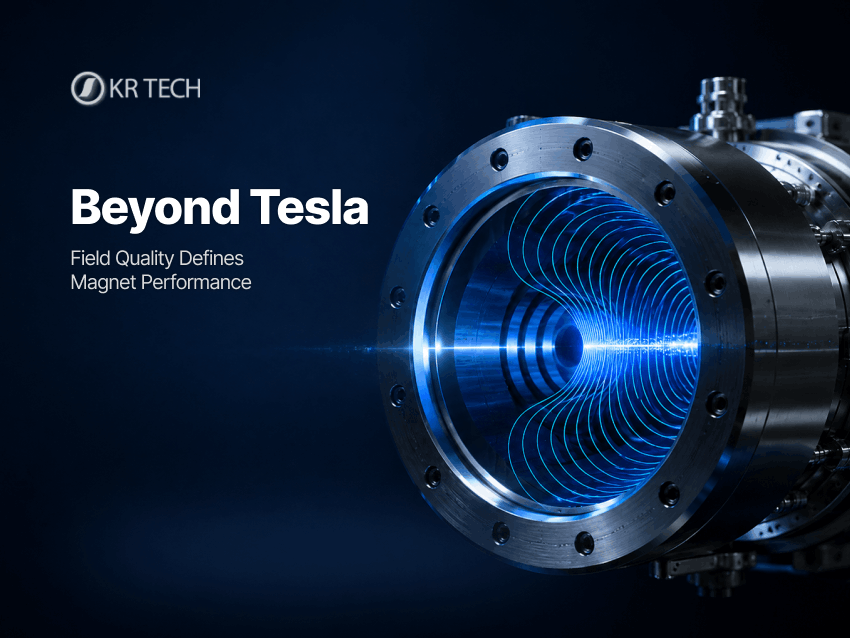
Even Identical 5T Magnets Can Deliver Different Performance
When describing superconducting magnets, the first figure usually mentioned is magnetic field strength. Figures such as 3T, 5T, and 7T intuitively illustrate the magnitude of the magnetic field a magnet can generate. However, in precision applications such as particle accelerators, heavy ion therapy devices, proton therapy beamlines, and high-energy physics experiments, it is difficult to judge a magnet’s performance based solely on magnetic field strength. Even for the same 5T magnet, actual performance can vary significantly depending on how uniformly the magnetic field is distributed, how stably it is maintained over time, and how effectively unwanted higher-order components are suppressed within the target region.
A key concept here is magnetic field quality. Magnetic field quality refers not merely to the ability to generate a strong magnetic field, but to how accurately the designed magnetic field is implemented and maintained within the required space. For magnets used in particle accelerators, magnetic field error within the Good Field Region—the area through which the particle beam passes—must remain within a defined tolerance range. This is because even a slight disturbance in the magnetic field distribution can affect the beam trajectory, focus, energy transfer efficiency, and device stability (Zhang et al., 2016; Diehl et al., 2024).
Therefore, the competitiveness of high-performance superconducting magnets does not end with “how high a Tesla can be produced.” The actual industrial and research value is determined by “how precisely that magnetic field can be designed, fabricated, measured, and verified.”
Why Magnetic Field Quality Matters in Particle Accelerator Magnets
In particle accelerators, magnets are not merely simple components but devices that guide, focus, and stabilize the beam in the desired direction. Dipole magnets bend the beam’s path, while quadrupole magnets focus the beam in a horizontal or vertical direction. In this process, the magnetic field generated by the magnet must theoretically possess a very distinct form. However, in actual magnets, differences from the ideal magnetic field occur due to various factors such as coil shape, core structure, manufacturing tolerances, cooling conditions, current stability, and the characteristics of the superconducting wire.
This difference is analyzed using indicators such as Field Uniformity, Multipole Harmonics, and Field Stability. Field Uniformity indicates how uniform the magnetic field is within the target region. Multipole Harmonics refers to higher-order magnetic field components that occur unnecessarily in addition to the main magnetic field components required by design. Field Stability is a concept that evaluates how much the magnetic field fluctuates due to factors such as time variation, current ramping, cooling conditions, and screening currents within the superconductor.
The reason these quality factors are important in accelerator magnets is that the beam reacts sensitively to even small differences in the magnetic field. In particular, as high-energy particle beams pass through multiple magnets in succession while traversing long-distance beamlines, small errors from individual magnets can accumulate. If magnetic field quality is not sufficiently ensured, problems such as beam loss, focus instability, reduced device efficiency, and decreased treatment precision may occur.
In other words, the performance of magnets for particle accelerators is evaluated not by the maximum value of the magnetic field strength, but by how accurately the magnetic field matches the design intent in the region through which the beam actually passes.
Why is there a performance difference even between identical 3T and 5T magnets?
Magnetic field strength is just one performance indicator of a magnet. Even with the same 3T magnet, if the magnetic field is concentrated only at the center and changes rapidly towards the periphery, it may not be suitable for precision applications. Conversely, even if a magnet generates a magnetic field of the same strength, if the magnetic field distribution within the target area is uniform, the higher-order harmonic components are low, and the drift over time is small, it can be evaluated as a magnet with much higher performance (Jang et al., 2021; Xu et al., 2025).
To understand this difference, it is necessary to distinguish between magnetic field strength and magnetic field distribution. Magnetic field strength is a value measured at a specific point. On the other hand, magnetic field distribution shows how the magnetic field is formed over an entire space. In precision equipment such as accelerators, MRI, NMR, and beamline systems, how predictably and reproducibly the magnetic field is formed within the entire effective area is more important than the magnetic field value at a single point.
In superconducting magnets, these differences can manifest in an even more complex manner. Superconducting wires are advantageous for generating strong magnetic fields due to their ability to achieve high current densities; however, they must simultaneously consider cooling conditions, electromagnetic forces, mechanical stress, insulation structures, and losses occurring during current changes. In particular, in high-temperature superconducting magnets, screening currents can occur due to the shape of the wire and current distribution, which can affect the spatial uniformity and temporal stability of the magnetic field.
Therefore, the design of a superconducting magnet is not merely a calculation to achieve a target Tesla. In actual design, coil placement, winding structure, magnet geometry, cooling paths, thermal stability, electromagnetic forces, insulation structures, and manufacturing tolerances must all be taken into account. Even if the magnetic field strength reaches the target value, if the quality of the magnetic field is not ensured, the magnet cannot be considered to have met the performance requirements of high-precision accelerator systems (Iwai et al., 2015; Zhao et al., 2026).

How are magnetic field quality measured for accelerator magnets?
Predicting magnetic field quality during the design phase alone is insufficient. Precise magnetic field measurements are required to verify whether the actual fabricated magnet meets the design specifications. A representative measurement method widely used for accelerator magnets is Rotating Coil Measurement.
Rotating Coil Measurement is a method that analyzes magnetic field components by measuring the induced voltage while rotating a coil sensor inside the magnet’s bore. This method is suitable for evaluating the field quality of accelerator magnets because it can isolate various multipole components, such as dipoles, quadrupoles, and hexoles. In particular, for quadrupole magnets, it allows for the identification of the presence of unnecessary higher-order harmonic components in addition to the main component, the quadrupole field (Rogacki et al., 2020).
Harmonic Analysis is the process of mathematically interpreting these measurement data. For an ideal quadrupole magnet, the necessary quadrupole component should be dominant, while other higher-order components should be as low as possible. However, in actual magnets, manufacturing errors, coil position deviations, core shape errors, mechanical vibrations, and sensor alignment errors can affect the measurement values. Therefore, in high-precision magnetic field measurements, procedures such as the mechanical stability of the sensor, rotation axis alignment, signal correction, reference radius setting, and feed-down correction become equally important.
Another method is Field Mapping. This involves directly measuring magnetic fields at multiple locations within a target space to construct a two- or three-dimensional magnetic field distribution. Field Mapping is useful for identifying not only the center of the magnet but also the end regions, fringe fields, and local field errors. Particularly for short magnets or magnets with complex shapes, a simple 2D harmonic model may not be sufficient, requiring a method that utilizes local field mapping in conjunction with rotating coil data.
In other words, magnetic field quality verification is the process of bridging design values with actual measurements. Manufacturers of high-performance magnets must possess not only electromagnetic design capabilities but also the ability to measure magnetic fields and interpret data simultaneously.
Magnetic field quality levels required for high-energy accelerators
High-energy accelerators impose very stringent requirements on magnetic field quality. Notably, in large-scale accelerator upgrade projects such as CERN’s HL-LHC, the field angle, multipole field error, and integrated field quality of superconducting quadrupole magnets must be measured with high precision. This is because beam optics operate under extremely sensitive conditions.
Since quadrupole magnets serve to focus the beam, deviations in the magnetic field gradient and higher-order components from the design range can cause fluctuations in beam size and position. Particularly in insertion zones or therapeutic beamlines where multiple magnets are arranged in sequence, errors in individual magnets directly impact the overall system performance. Therefore, for accelerator magnets, it is crucial not only to achieve the target field gradient but also to manage multipole error within a reference radius to the ppm or 10^-4 level.
This trend is clearly evident in recent research on superconducting accelerator magnets. Designs such as Canted-Cosine-Theta structures and Discrete Cosine-Theta structures are garnering attention as methods for achieving high field quality. This structure is designed to approximate a current distribution close to an ideal multipole field and is advantageous for simultaneously achieving miniaturization and high performance of magnets. Research is also underway in high-energy beamlines for proton therapy to utilize superconducting magnets to reduce system size while ensuring field uniformity (Liang et al., 2025; He et al., 2025).
As such, the criteria for evaluating magnet performance in high-energy accelerators and medical particle therapy systems are becoming increasingly precise. This is because high magnetic field strength, small device size, stable cooling, low loss, and high magnetic field quality must all be satisfied simultaneously. This implies that design, fabrication, measurement, and verification must be operated as a single integrated engineering system rather than as separate processes.
Magnetic field quality begins at the design stage.
Magnetic field quality is not secured solely during the measurement phase. Rather, the key lies in establishing field quality as a target performance criterion from the early stages of design. In the design of accelerator magnets, 2D FEM and 3D FEM are utilized to analyze the magnetic field distribution within the bore, effective length, fringe field, higher-order harmonic components, electromagnetic force, core saturation, and coil placement errors in advance (Diehl et al., 2024; He et al., 2025).
2D FEM is useful for rapidly analyzing the magnetic field distribution and multipole components in the magnet cross-section. This allows for the optimization of coil position, pole shape, yoke geometry, and shim structure. 3D FEM can account for longitudinal effects, end structures, actual assembly geometry, and the influence of mechanical structures. Since integrated field quality is particularly critical for accelerator magnets, simple cross-sectional analysis alone is insufficient.
Recently, optimization techniques such as genetic algorithms, multi-objective optimization, and parametric modeling are also being utilized in magnet design. This method allows for the simultaneous consideration of magnet size, material usage, manufacturing difficulty, and cost while improving field quality. In other words, good magnet design is not about creating the strongest magnetic field, but rather the process of finding a structure that is manufacturable and verifiable while satisfying the required magnetic field quality.
KR TECH's Magnetic Field Design and Verification Capabilities
KR TECH is a company that has accumulated design, manufacturing, and testing capabilities in the fields of electromagnets, superconducting magnets, and beamline systems for particle accelerators. In industries requiring high-precision magnets, simply meeting the magnetic field strength demanded by customers is not sufficient. It is equally important to ensure that the magnetic field distribution satisfies target performance under actual operating conditions, is suitable for the beam stability of the accelerator system, and is designed with a structure that can be verified after manufacturing.
KR TECH’s competitiveness lies in its integrated capabilities that combine 2D FEM and 3D FEM-based electromagnetic field analysis, field optimization, magnetic measurement, and quality validation. During the design phase, target magnetic field strength and field quality are considered simultaneously; during the manufacturing phase, the precision of coil geometry and mechanical structures is managed; and during the verification phase, the difference between design values and actual measurements is verified through magnetic field measurement data.
In particular, for magnets used in particle accelerators, the required field quality standards vary depending on the role of each magnet, such as dipoles, quadrupoles, correctors, and beamline magnets. KR TECH can perform customized magnet design and manufacturing reflecting these requirements, and supports the implementation of reliable equipment through magnetic field analysis and measurement-based verification.
Conclusion: The True Benchmark of High-Performance Superconducting Magnets Goes Beyond Tesla
When discussing the performance of superconducting magnets, magnetic field strength is a crucial starting point. However, in precision accelerators, medical particle therapy, high-energy beamlines, and research superconducting systems, the value of a magnet cannot be judged solely by its Tesla value. Actual performance is determined by how uniform the magnetic field is within the target region, how low unnecessary multipole harmonics are, how stable it is over time, and how closely the design values match the actual measurements.
Therefore, the core of high-performance superconducting magnets is not field strength, but field quality. Beyond the technology of generating strong magnetic fields, the technology to design and verify precise magnetic fields is the essential competitive edge of the accelerator magnet industry.
KR TECH provides magnet and superconducting magnet solutions for high-precision particle accelerators based on its capabilities in electromagnetic field analysis, magnet design, fabrication, magnetic field measurement, and quality verification. The ability to design performance beyond magnetic field strength—that is, field quality—is the standard for the high-performance magnet technology that KR TECH pursues.
References
References
-
Electrical Engineering, 106
Diehl, E., von Tresckow, M., Scholtissek, L., Loukrezis, D., Marsic, N., Müller, W. F. O., & De Gersem, H. (2024). Quadrupole magnet design based on genetic multi-objective optimization. Electrical Engineering, 106, 1179–1189.
DOI -
Physica C: Superconductivity and Its Applications, 635
He, G., Zhu, Y., Yang, W., Liang, Y., Lei, Y., Yang, Y., Chang, P., Ma, L., Chen, G., Wang, K., Zhang, X., Wang, K., & Liao, T. (2025). Design of superconducting magnets for high energy beam transport lines for proton cancer therapy. Physica C: Superconductivity and Its Applications, 635, 1354718.
DOI -
Physics Procedia, 67
Iwai, S., Takahashi, M., Miyazaki, H., Tosaka, T., Tasaki, K., Hanai, S., Ioka, S., Watanabe, K., Awaji, S., & Oguro, H. (2015). Concept of a cryogenic system for a cryogen-free 25 T superconducting magnet. Physics Procedia, 67, 326–330.
DOI -
Applied Sciences, 11(7)
Jang, J. Y., Kim, M. S., Hwang, Y. J., Song, S., Choi, Y., & Choi, Y. S. (2021). Development of a cryogen-free compact 3 T superconducting magnet for an electromagnetic property measurement system. Applied Sciences, 11(7), 3074.
DOI -
Physica C: Superconductivity and Its Applications, 629
Liang, Y., Ou, X., Mei, E., Ni, D., Zhou, L., Han, Z., Chen, Y., Wu, W., & Yao, Q. (2025). Design and test of a canted-cosine-theta superconducting quadrupole magnet for CiADS project. Physica C: Superconductivity and Its Applications, 629, 1354646.
DOI -
Journal of Sensors and Sensor Systems, 9
Rogacki, P., Fiscarelli, L., Russenschuck, S., & Hameyer, K. (2020). Development of a rotating-coil scanner for superconducting accelerator magnets. Journal of Sensors and Sensor Systems, 9, 99–107.
DOI -
Scientific Reports, 15
Xu, Z., Wang, H., Feng, Z., Wu, H., Xiao, J., Chen, Q., Wang, S., Cheng, J., Wang, L., Wang, Y., Liu, J., Xu, C., & Wang, Q. (2025). Design and simulation of a 7.0 T conduction cooled superconducting magnet. Scientific Reports, 15, 15699.
DOI -
Progress in Superconductivity and Cryogenics, 18(2)
Zhang, Z., Wei, S., Lee, S., Jo, H. C., Kim, D. G., & Kim, J. (2016). Harmonic analysis and field quality improvement of an HTS quadrupole magnet for a heavy ion accelerator. Progress in Superconductivity and Cryogenics, 18(2), 21–24.
DOI -
Cryo, 2(1)
Zhao, S., Miao, Z., Wu, Z., Huang, R., & Li, L. (2026). Research progress of epoxy-based composites for insulating encapsulation of superconducting magnets. Cryo, 2(1), 2.
DOI